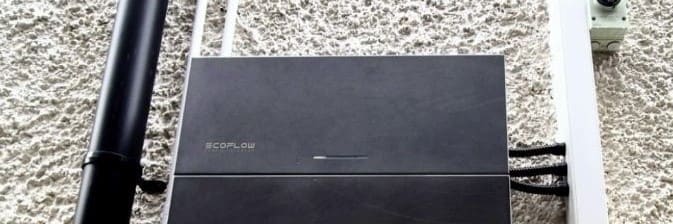
How the EcoFlow PowerOcean battery works
A plain-English guide for EcoFlow owners
Your EcoFlow PowerOcean battery does something clever that most batteries don't. Inside every 5.1 kWh pack, there's a built-in voltage converter that boosts the internal power to 800 volts before it ever leaves the casing. That is roughly 16 times higher than a conventional solar battery.
That single design decision is the reason your system is more efficient, why it works with just one pack, and why adding a second or third battery years down the line doesn't cause any problems. This page explains how it all fits together, in plain English.
Two words are worth knowing before we go further, because they explain almost everything on this page. Voltage is the push behind electricity, a bit like water pressure in a pipe. Current is the amount of electricity actually flowing. You can deliver the same amount of power with a high voltage and a small current, or a low voltage and a large current. The inverter is the box in your home that changes the electricity your panels and battery make into the type your appliances can use.
Does this conversion waste energy?
Every conversion between voltages loses a small amount of energy as heat. The EcoFlow's internal converter loses roughly 1–3% in this step. However, by doing this inside the battery, the much larger main inverter now only has to do a simple step-down (800V → 230V AC) rather than a large step-up from 48V. That cuts inverter losses from around 8–10% down to just 2–3%. The net result is a more efficient system overall, not less efficient.
What's inside your EcoFlow battery?
The cells inside your EcoFlow battery are made by CATL, one of the world's largest battery manufacturers, using Lithium Iron Phosphate (LFP) chemistry. LFP is the same type used in most quality solar batteries. It is known for being safe, long-lasting, and tolerant of being fully charged and discharged on a daily basis.
Internally, those cells are arranged to produce around 48 volts, the same voltage level used in other popular solar batteries like Dyness and WeCo. At this point the EcoFlow is, electrically speaking, a conventional battery.
But it doesn't stop there.
The built-in converter — the clever bit
Inside every single EcoFlow battery pack, there is a dedicated DC-DC converter. Its job is to take the ~48V coming from the cells and step it up to 800V DC before the power exits the battery.
EcoFlow describe it like this in their own installer documentation:
"Built-in DC-DC converter in each battery pack: independent conversion between 48V and 800V, allowing our 3-phase hybrid inverter to simply operate with only one pack."
The converter runs continuously and the 800V output stays fixed and stable, whether the battery is nearly full or almost empty. Your inverter always sees the same steady supply.
Why high voltage means better efficiency
To understand why 800V matters, think about a garden hosepipe. You can move the same amount of water through a narrow hose at high pressure, or through a wide hose at low pressure. High voltage is the electrical equivalent of high pressure: you can deliver the same amount of power using a much smaller current.
When current flows through cables and components, it generates heat, and that heat is wasted energy. High voltage means lower current for the same power delivery, so less heat is generated and less energy is lost.
A conventional 48V battery system has to push a very large current through the inverter to deliver useful power. The EcoFlow's 800V output delivers the same power at a fraction of the current, which is why the main inverter runs cooler and wastes less energy. Over a full year of daily charging and discharging, that difference adds up to several hundred kilowatt-hours of additional solar energy actually reaching your home rather than being lost as heat.
| Battery type | Voltage to inverter | Typical inverter loss |
|---|---|---|
| Standard low-voltage battery (e.g. Dyness, WeCo) | 48V | ~8–10% |
| EcoFlow PowerOcean | 800V | ~2–3% |
Starting with just one battery
With most high-voltage battery systems, you can't start small. They reach their operating voltage by chaining multiple modules together one after another. You might need eight modules wired up before the inverter sees enough voltage to switch on. That forces customers to buy a large amount of storage upfront.
Because every EcoFlow pack has its own built-in converter and independently produces 800V, your inverter receives a full 800V supply from a single 5.1 kWh pack. The system runs at full voltage from day one, even with just one battery installed.
This means you can start with the storage capacity you need now, and expand later as your energy needs grow, without paying for excess capacity upfront.
The EcoFlow single-phase system supports up to 3 packs (15.3 kWh total). This is a hard system limit, not just a recommendation.
Adding more batteries later — even years down the line
In most battery systems, mixing a new pack with an older, partially worn-down pack causes a problem: the newer, stronger battery is held back by the weaker one. Think of a team of people carrying a heavy object: the pace is set by the slowest person. This is sometimes called the "weakest link" effect.
EcoFlow's design solves this completely. Because each battery pack contains its own independent converter and manages its own 800V output, the packs are wired side by side on a shared connection, rather than being chained one after another. Each pack looks after itself.
The practical result: a battery bought today and a battery bought five years from now can work side by side in the same system, each contributing fully, without the older pack holding back the newer one. You don't need to replace all your batteries at once, and you never lose the benefit of upgrading one pack at a time.
Need a hand?
Get in touch with the PureVolt team. We're happy to answer any questions about how your system is performing or what your options are for expanding storage in the future.
You might also find these guides useful:
- EcoFlow WiFi settings — reconnecting after a router or password change.
- Battery charging and discharging explained — understanding normal battery behaviour.
- All the battery brands we install — specs and datasheets for every battery we offer.